
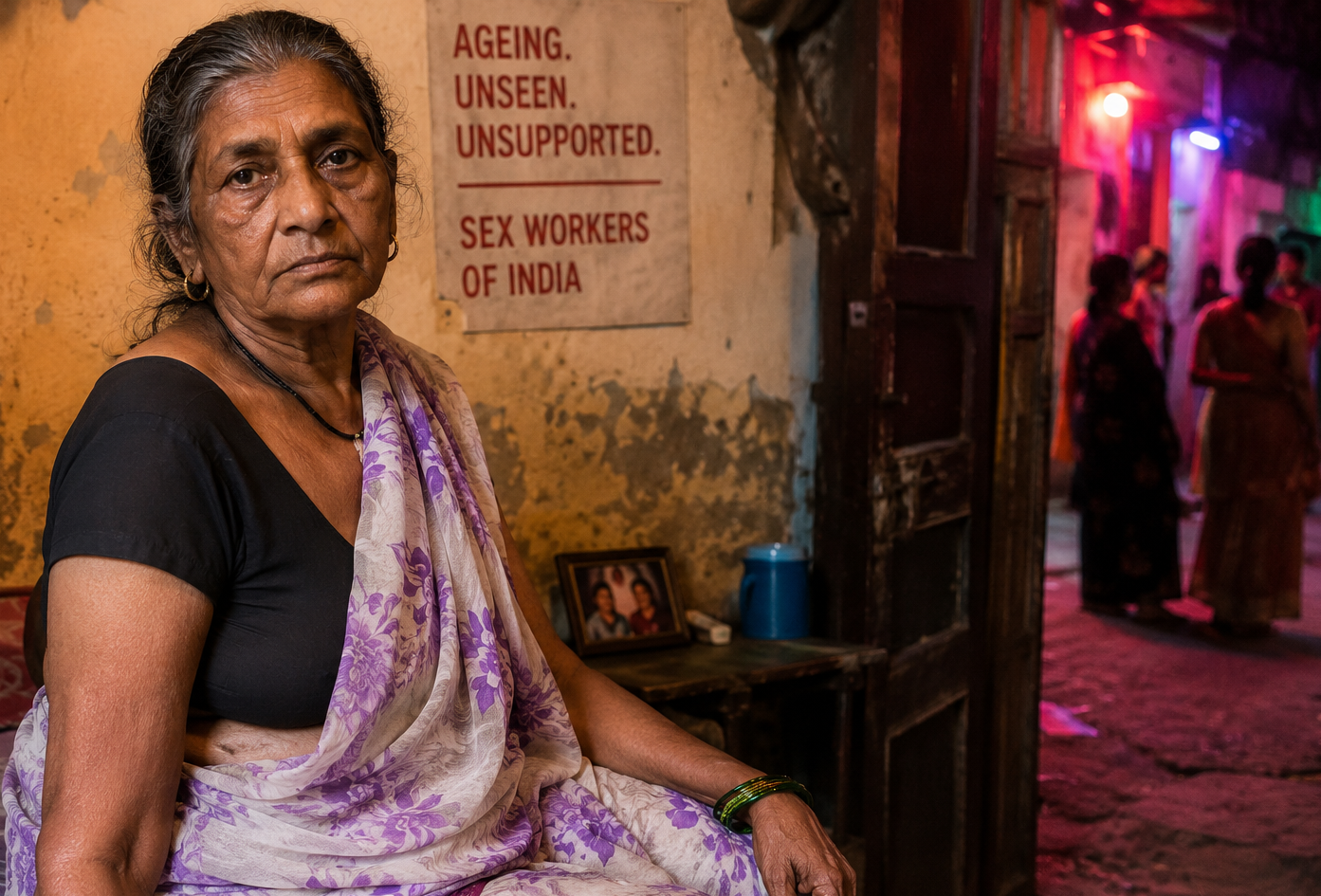
In Mumbai’s Kamathipura and Falkland Road, two of the country’s oldest and most infamous red-light districts, there is an unspoken actuarial table that every woman in the trade eventually confronts. Her earning years are short, often ending by her mid-thirties or forties. What comes after is rarely discussed in policy documents, and almost never in public conversation.
“Women who are engaged in the sex trade essentially would have only a couple of productive years for the trade per se,” says Kashina Kareem, Assistant Director at Prerana, an NGO working against human trafficking. “Typically when they cross that age, they may not be viable for the trade itself.”

What follows is not retirement in any conventional sense. It is a quiet, largely invisible second act—one shaped by poverty, illness, stigma, and a welfare system that was never designed with ageing in mind.
The Myth of the Golden Years
For women who remain within the red-light economy after their earning capacity declines, the trade absorbs them into new, unpaid or underpaid roles. Kareem describes women becoming brothel in-charges, or taking on domestic labour—cleaning, cooking, caretaking for younger women and their children. It is less a career transition than a demotion dressed up as continuity.
Dr Rennie Joyy, founder of Aalekh Foundation, paints a starker picture of what happens when even that informal safety net isn’t available: many women simply keep working through poor health because there is no alternative income, or fall back on low-paying informal labour, or become dependent on others.

This isn’t a fringe problem. A 2012 study of 240 former and 340 current sex workers across Karnataka and Maharashtra found that, counterintuitively, former sex workers tend to fare better financially in old age than female-headed households in the general population, but the same research identified serious structural barriers: women in the trade have little access to mechanisms for investing savings productively during their working years, and old-age security is further eroded by high out-of-pocket health costs and borrowing. Contrary to common assumptions, the researchers also found that traditional family support systems that many ageing Indians rely on are largely unavailable to former sex workers.
A more recent phenomenological study of 39 street- and home-based sex workers in Karnataka reached a similar conclusion: ageing brought financial instability, a lack of alternative livelihood options, and limited access to government benefits and social security. Notably, the same research found that women’s expectations of support from their own grown children often went unmet—a unravelling of the assumption that family will step in where the state does not.
A Body That Remembers
Ask anyone who has worked closely with older sex workers what ageing looks like physically, and the same list of conditions surfaces: sexually transmitted infections, tuberculosis, joint pain, hypertension, diabetes, reproductive health complications.
“Sexually transmitted infections are definitely the top illness factor,” Kareem says. “Back in the day, in the 90s and early 2000s, it used to be HIV as well, and HIV essentially affects the immune system.”
Many of the older women Prerana works with today are HIV-positive, a legacy of the epidemic’s peak years, which leaves them more vulnerable to infections a healthier body could otherwise fight off. Tuberculosis, she notes, spreads easily in the cramped conditions of Kamathipura and Falkland Road, compounding the risk for women whose immunity is already compromised.
The data bears this out at scale. In Kolkata’s Sonagachi, often described as Asia’s largest sex-work district, a 1992 baseline survey found that 81 percent of sex workers had at least one sexually transmitted disease, and almost none used or even knew about condoms.
Decades later, as that generation has aged, the disease burden has shifted rather than disappeared: the community’s most pressing concern now is treating older women who, as they age, become newly susceptible to the kind of non-communicable diseases that come with age itself—heart disease, diabetes, hypertension.
Compounding this, India’s public health spending remains just above 1 percent of GDP, pushing most healthcare costs onto a population that can least afford them.
A qualitative case study of six older female sex workers (aged 60 and above) at Sonagachi, published in 2023, framed the problem as compounding disadvantage: these women are marginalised twice over—once for their former profession, and again simply for being old. The study’s authors called for vocational training to build alternative income sources, along with pension schemes and dedicated old-age housing for older sex workers.
The Mind Carries Its Own Weight
The psychological toll of ageing in the sex trade is less visible than the physical one, but no less real, says Mumbai-based psychologist Rasshi Gurnani. “Ageing can intensify concerns around identity, financial insecurity, and self-worth, particularly in a profession where youth is often highly valued,” she explains. “Prolonged exposure to stigma can also contribute to chronic stress and diminished psychological wellbeing.”

Gurnani describes a specific kind of injury that comes with declining income: a hit not just to finances but to self-perception. “A decline in income can trigger feelings of rejection, anxiety, and reduced self-efficacy, especially if a person’s identity has become closely linked to their work.” Layered on top of that is a heightened risk of social isolation. Ageing sex workers, she says, often experience “invisibility” in spaces that prize youth, which erodes emotional security over time.
Years of accumulated stigma don’t stay external, either. “Long-term exposure to stigma can lead to internalised stigma, where negative societal attitudes become part of one’s self-perception,” Gurnani says, a slow process that can produce chronic anxiety, shame, and depressive symptoms well into later life.
And yet, resilience is the other half of this story. Gurnani has observed real psychological strength among the women she has worked with—adaptability, emotional regulation, and dense peer-support networks that function almost like extended family. “Their lived experiences often foster problem-solving skills and a deep capacity to navigate adversity,” she says. What helps most, in her experience, is exactly what the system tends not to provide: stable community, consistent relationships, and a sense of identity that exists outside of work.
But few older sex workers access formal mental healthcare at all. Gurnani points to anticipated judgment, past negative experiences with the healthcare system, and fear of discrimination as the biggest deterrents—barriers that, she says, mental health professionals can only dismantle through trauma-informed, non-judgmental care that treats these women with the same baseline respect afforded to any other patient.
A Welfare System Built for Someone Else
On paper, government schemes for marginalised women do not distinguish between those who entered sex work voluntarily and those who were trafficked into it. “The government doesn’t go into the background of whether a woman was trafficked or whether she voluntarily engages in the sex trade,” Kareem says. “Whatever is available for women from a certain marginalised background is available for these women as well.”
In practice, access is the whole battle. Dr Joyy identifies documentation as the single biggest chokepoint: women who have migrated across state lines, often without ration cards or other proof of identity, simply fall outside the reach of “universal” schemes.
Prerana’s advocacy work has chipped away at this—the organisation successfully pushed for a system of annually renewed food cards for women who cannot obtain standard ration cards, giving them access to subsidised grain despite lacking conventional documentation.
The flagship government programme aimed at this population, Ujjwala, is meant to fund rescue, rehabilitation, and reintegration for trafficking victims through shelter homes, medical care, legal aid, and vocational training. But Kareem argues its foundational problem is structural: the scheme is meant to work alongside the Immoral Traffic (Prevention) Act, 1956, India’s core anti-trafficking legislation, yet the two rarely align in practice. Funding for the homes and their staff, she says, is “pretty substandard”, and the vocational training on offer hasn’t evolved meaningfully in over a decade. “Even today, the same kind of programmes are being suggested by the government” that were being suggested fifteen or twenty years ago, with little regard for what skills the current job market actually rewards.
Legal scholars examining the ITPA have raised a related concern: the law’s rescue-and-custody provisions, meant to protect trafficking victims, can end up applying broadly to any woman found in a brothel, even adult women can be placed in protective custody until a magistrate deems their family or guardian “suitable” to take charge of them, based partly on assessments of their own age and character. Critics argue this collapses the distinction between protection and punishment, particularly for women who have spent decades in the trade and have nowhere else to “reintegrate” into.
What Would Actually Help
The people working closest to this population are strikingly specific about what’s missing. Dr Joyy’s list: universal, non-discriminatory access to pensions, healthcare, and social security; expanded livelihood and skilling programmes—tailoring, catering, caregiving, beauty services, handicrafts—backed by real financial support, not just workshops; and stronger community-based infrastructure, including mental health services, safe housing, and legal aid built specifically around the realities of ageing in this trade.
Academic research converges on much the same list. The Sonagachi case study called for pension plans and dedicated old-age homes designed for older sex workers, rather than generic elder-welfare infrastructure that assumes a family support structure many of these women simply don’t have.
What emerges from talking to advocates, clinicians, and researchers is a picture of a policy blind spot hiding in plain sight. India has, over decades, built an extensive (if imperfect) vocabulary for discussing trafficking, rescue, and rehabilitation. It has built almost no vocabulary for what happens to the woman who was never “rescued,” who spent thirty years in the trade, and who is now sixty, HIV-positive or diabetic, unpensioned, and largely on her own. She is neither the victim the law imagines nor the retiree the welfare state is built to support. She exists, mostly, outside both categories, which is exactly why she has been so easy to overlook.